

In January 2027, the entire handball world will be watching closely as Germany hosts the 2027 IHF Men’s World Championship. From 13 to 31 January, the world's top handball nations will compete for the title of world champions. But who are the favorites? Who are the star players? And which coaches will be leading the top nations? Here is an overview. Today’s focus: Island.
One-on-one specialists without star attitude
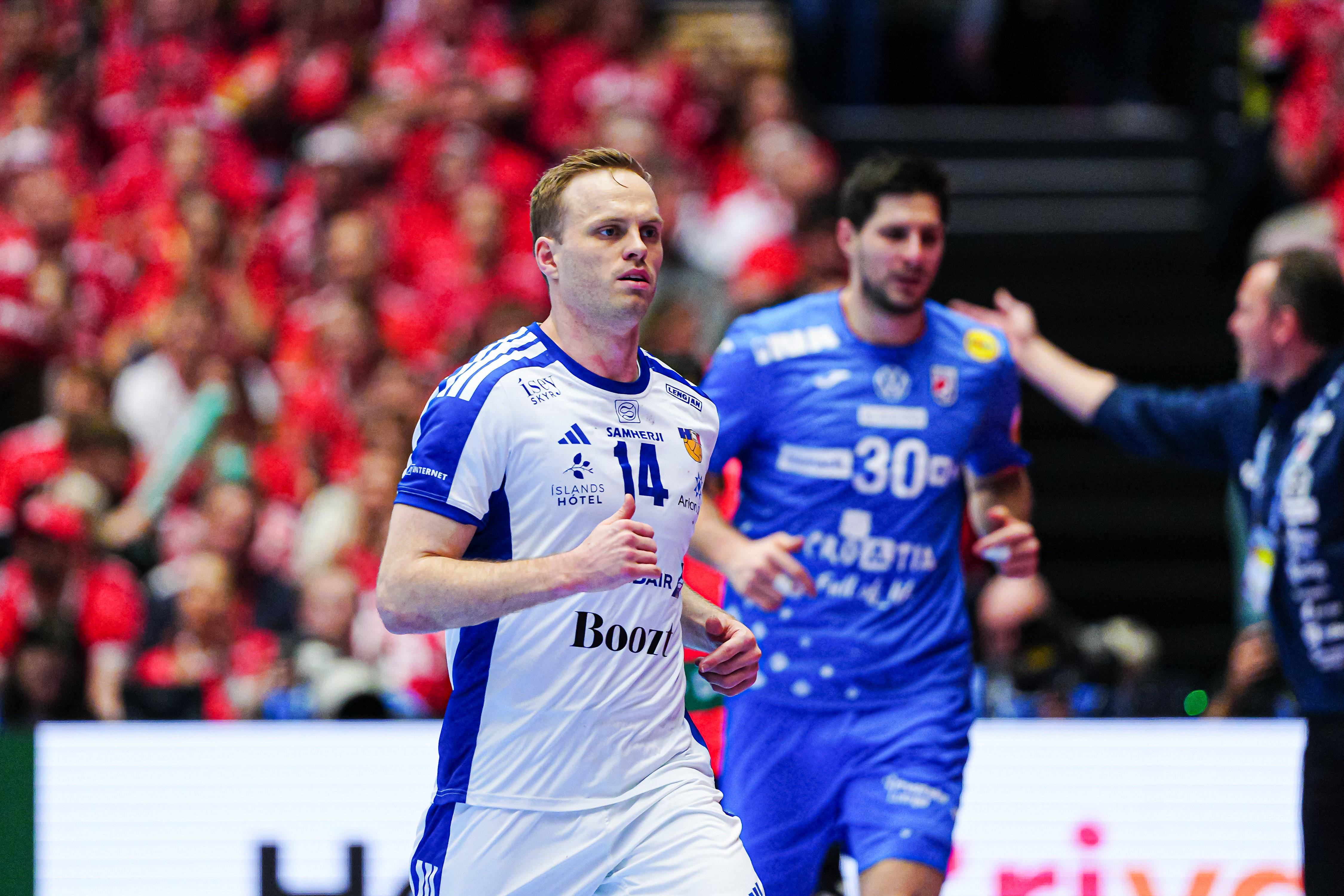
Gísli Kristjánsson will never forget the 18th of June 2023. On that day, he celebrated his first EHF Champions League title with SC Magdeburg. Just one day earlier, the playmaker had suffered a shoulder injury in the semi-final. The diagnosis: surgery required. But Kristjánsson pushed through the pain, played in the final, won the title with his team and was named MVP of the Final Four. The story highlights one of his greatest strengths: the Icelander fears no physical battle. He constantly takes on defenders in one-on-one situations – and often wins thanks to his outstanding skills. Iceland’s playing style is built around exactly these qualities, and the 26-year-old masters them like few others.
In the right back position, Iceland features another player with similar strengths: Kristjánsson’s SC Magdeburg teammate Ómar Ingi Magnússon. Since 2020, the two have been key figures in Magdeburg’s attacking play, playing a major role in the club’s recent success, including:
- EHF European League winner 2021
- EHF Champions League winner 2023 & 2025
- IHF Men’s Super Globe winner 2021, 2022 & 2023
- German champion 2022 & 2024
- DHB Cup winner 2024
In addition to their one-on-one ability, Magnússon and Kristjánsson share another trait: composure. Neither is known for vocal leadership – instead, they let their performances on the court speak for themselves.
The third member of this trio of duel specialists is Janus Smárason. The 31-year-old is a natural centre back but often operates on the left for Iceland. Since 2024, he has been playing for Hungarian side OTP Bank-PICK Szeged. Previously, he teamed up with Kristjánsson and Magnússon at SC Magdeburg, meaning the trio is highly familiar with each other. Like his teammates, Smárason is defined by strength in duels and composure. These qualities will be key for Iceland at the 2027 World Championship, where the team aims to go as far as the final weekend in Cologne from 29 to 31 January. It would be a historic achievement.
One of the heroes of 2008 is now on the sideline
Iceland’s greatest handball success dates back to 2008 – and remains the nation’s biggest Olympic achievement: silver at the Beijing Olympic Games. That team featured world-class players such as Ólafur Stefánsson, Guðjón Valur Sigurðsson and Alexander Petersson.
The key figure in that team, however, was playmaker Snorri Steinn Guðjónsson. With 48 goals, he finished second in the scoring charts and was named best centre back of the tournament. Over his career, Guðjónsson earned 257 caps and scored 846 goals for Iceland. Today, he leads the national team as head coach.
Guðjónsson began his playing career at Valur Reykjavík before moving to Germany in 2003 to join TV Großwallstadt. Further stops included GWD Minden, GOG Handbold, and Rhein-Neckar Löwen. After additional spells in Denmark and France, he returned to Valur Reykjavík, where he ended his career in 2017 and immediately began coaching. In 2023, he left Valur to take over as Iceland’s national team coach.
In January 2026, he guided the team to fourth place at the EHF EURO. Following that success, Iceland now aims to challenge for top positions at the IHF Men’s World Championship 2027.
Olympic silver 2008 remains Iceland’s benchmark
Handball holds a special place in Iceland. Many children grow up playing the sport in clubs across the country, and many go on to compete abroad – with the very best reaching the national team. At club level, Icelandic players have enjoyed major success, as seen with Kristjánsson and Magnússon. However, similar success has largely eluded the national team.
Iceland has participated in 23 World Championships but has never reached the semi-finals. Their best result remains fifth place in 1997, while their lowest finish was 20th in 2021.
At the European Championships, Iceland has qualified 14 times and reached the semi-finals on three occasions – losing each time. They also lost the bronze medal match in 2002 and 2026, but secured bronze in 2010 with a 29:26 victory over Poland.
The team has been most successful at the Olympic Games. Iceland has qualified seven times, reaching the semi-finals in 1992 and finishing fourth. In 2008, they achieved their greatest success with silver, only losing in the final to France’s star-studded team led by Nikola Karabatić and Thierry Omeyer.
Home advantage in the preliminary round
Now, Iceland hopes to make history at the IHF Men’s World Championship 2027 in Germany by reaching its first-ever semi-final. Qualification has already been secured thanks to a fourth-place finish at the EHF EURO 2026. The path to Cologne is also clearly mapped out:
As the top-seeded team in Group H, Iceland will benefit from a unique advantage. Gísli Kristjánsson, Ómar Ingi Magnússon and Elvar Örn Jónsson – all playing for SC Magdeburg – could enjoy three “home” matches during the preliminary round at the GETEC Arena in Magdeburg.
If Iceland progresses to the main round, their journey would continue at the ZAG Arena in Hanover, where they would face teams from Group G, led by Denmark. The preliminary round opponents will be drawn on 10 June at the Hofbräuhaus in Munich.